
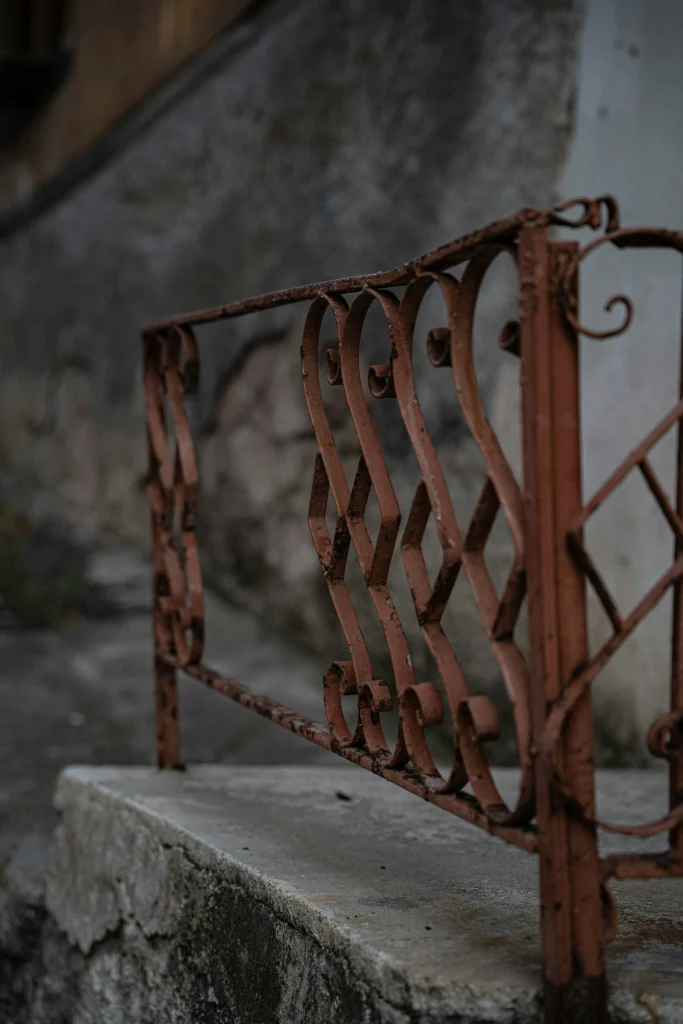
Handrail repair for older homes usually starts at the bottom: most wobbly metal railings are loose because the posts have rusted or broken free where they enter concrete steps, brick or a wood porch. A welder cuts back the damaged base, adds a new base plate or post section, re-anchors it with proper fasteners or grout, and repairs cracked joints so the rail feels solid again.
Older homes have a lot of charm in their ironwork. Twisted pickets, scrolled newels and simple pipe rails on a front stoop all say something about when the house was built. They also come with age-related problems: decades of rust, anchoring methods that were common at the time but do not hold up, and spacing and heights that do not match what is expected on new construction. The goal of a good repair is to make the rail safe and solid while keeping as much of the original character as you want to keep.
Key takeaways
- Most loose rails fail at the post base, where water, rust and old anchoring methods meet.
- Rust expanding inside a concrete step can crack the concrete around a post, a process often called rust jacking.
- Repairs usually involve cutting out rotten metal, adding base plates or new post sections, and re-anchoring with modern fasteners or non-shrink grout.
- Older rails often fall short of current height and spacing guidelines. A repair may not require an upgrade, but replacement often does, so confirm with your local building department.
- Homes built before 1978 may have lead paint on metal railings, which changes how old paint should be removed before welding.
Why railings on older homes come loose
A railing is only as solid as its connection to the house, the steps or the porch. On many older homes, steel posts were simply set into wet concrete when the steps were poured, or dropped into holes in brick and filled with mortar or lead. That works well for a while. Then water finds its way down along the post, and the steel below the surface starts to rust where nobody can see it.
Rust jacking in concrete steps
Rust takes up more space than the steel it replaces. As a post rusts inside a concrete step, the expanding rust pushes outward and cracks the concrete around it. You might see a spiderweb of cracks around the base, a chunk of the step edge breaking away, or a post that rocks in a hole that is now a size too big. Once that starts, it speeds up, because the cracks let in more water.
Rusted-through post bottoms
Sometimes the concrete is fine and the post itself has rusted through right at the surface, leaving a thin shell of steel or nothing at all. Pipe and hollow tube posts are especially prone to this because water collects inside them. A post can look solid from above and snap off at the base with a firm push.
Loose fasteners and failed welds
Rails mounted to wood porches or brick walls with lag screws or anchors loosen as wood shrinks and swells and old anchors corrode. Joints between the rail and posts can crack at their welds after years of people pulling on them. Decorative castings, often cast iron on older rails, can crack from a single impact and do not take a weld the same way steel does.
How serious is a loose handrail?
A handrail is there for the moment someone slips, misses a step or needs to steady themselves. That is exactly when a loose rail fails. For older family members, guests unfamiliar with the steps or anyone carrying groceries, a rail that moves is worse than no rail at all, because people trust it.
Signs that it is time for a repair rather than a watch-and-wait:
- The rail moves more than slightly when you push or pull on it at the top.
- Concrete around a post base is cracked, spalling or broken away.
- You can see daylight, flaking scale or holes at a post base.
- Welds at joints are cracked or a section rattles.
- A post has been patched with caulk, foam or extra concrete and is moving again.
How a welder repairs loose posts and rusted bases
The fix depends on what we find once the base is exposed. Here are the common approaches for residential railings, all of which can usually be done on-site.
Cut back and plate
If the post is sound above the surface, the rusted section is cut off cleanly. A new steel base plate is welded to the post, and the plate is anchored to the step or porch with stainless or galvanized concrete anchors or epoxy-set threaded rod. The old hole is cleaned out and filled. This surface-mount approach keeps water from sitting around the post in the future.
Splice a new post section
Where the rail’s appearance depends on the post running into the step, a new length of matching tube or bar can be spliced to the sound upper post. The new section is set into a cleaned or freshly core-drilled hole and secured with non-shrink grout or anchoring epoxy, then crowned so water runs away from the post instead of into the hole.
Repair the concrete
Cracked step edges around a post usually need patching after the metal work is done. Small repairs can be handled with patching mortar. If a step is badly broken or settling, a concrete contractor may be the right call, and we will say so before welding a new rail to failing concrete.
Re-anchor to wood porches and brick walls
On wood porches, rail posts are often lagged into framing that has shrunk, split or softened over the years. The fix starts with checking the wood itself. Sound framing can take new through-bolts with backing plates, which hold far better than lag screws alone. If the wood is rotted, a carpenter needs to replace it before the rail is reattached.
Wall-mounted handrail brackets on brick or stone usually loosen because old anchors corroded or the mortar joint around them crumbled. New brackets are set into solid brick or stone, not the mortar, with stainless anchors or epoxy-set rod, so the rail stays tight even when someone leans their full weight on it.
Re-weld joints and replace damaged sections
Cracked welds are ground out to clean metal and re-welded, typically with MIG or stick on mild steel. Badly bent or rusted pickets can be cut out and replaced with matching stock. For cast iron decorative pieces, brazing or replacement with a steel or cast reproduction is often more reliable than standard welding.
Safety guidelines for older railings
Building codes for railings have changed over the decades, and many older homes were built before today’s common rules. The figures below are typical of what current residential codes call for, but requirements vary and change, so always confirm with your local code official.
- Handrail height: typically 34 to 38 inches, measured vertically from the nosing of the stair treads.
- Guard height: porches, decks and landings more than about 30 inches above the ground typically need a guard at least 36 inches high on homes.
- Opening size: guards are commonly required to have openings small enough that a 4-inch sphere cannot pass through, which protects small children.
- Graspability: handrails are typically expected to have a shape you can wrap your hand around, such as round stock roughly 1-1/4 to 2 inches in diameter, or an equivalent profile.
- Strength: rails and guards are typically designed to resist a significant concentrated load at the top without failing.
Older rails commonly have wide picket spacing, low heights or flat bar tops that are hard to grip. Whether a repair must bring those up to current standards depends on local rules and the scope of work. Fixing an existing rail in place is often treated differently from tearing it out and installing a new one. If you are unsure, ask the city before work begins.
Making an older rail safer without replacing it
You can improve safety while keeping original ironwork. Options include adding intermediate pickets that match the originals to close up wide spacing, welding a graspable round rail on top of or alongside a flat-bar rail, extending a rail to the bottom step, or adding a second rail on the other side of a wide stair. These small changes make a real difference to someone steadying themselves.
Historic districts, lead paint and other old-house details
San Antonio has many well-loved older neighborhoods, from King William and Monte Vista to Tobin Hill, Dignowity Hill and parts of Alamo Heights. If your home is in a designated historic district or is an individual landmark, exterior changes such as replacing a railing may need review. The City of San Antonio’s Office of Historic Preservation can tell you whether approval is required before work starts. Like-for-like repairs are often simpler than changes in design.
Homes built before 1978 may have lead-based paint on their railings. Grinding, sanding or heating that paint during welding can release lead dust and fumes. Before welding, old paint at the work area should be tested or treated as lead-containing and removed with appropriate methods, such as chemical stripping or careful mechanical removal with containment and cleanup. Ask any contractor how they handle it.
Finally, matching an old finish takes some thought. Many older rails have dozens of paint layers. A repair can be spot-primed and painted to match, or you can use the repair as a chance to strip and refinish the whole rail for a uniform look and better rust protection.
What drives the cost of handrail repair?
- Number of failing posts. One loose post is a small job. Every post in a long porch rail is a bigger one.
- Base condition. Plating a sound post is quicker than splicing new sections and re-grouting.
- Concrete or masonry repair. Broken steps or loose brick may need patching or another trade.
- Safety upgrades. Adding pickets, a graspable rail or extensions adds material and fabrication.
- Paint handling. Lead-safe removal and a full refinish take more time than spot priming.
- Ornamental matching. Reproducing scrolls, twisted pickets or cast pieces takes extra shop time.
Handrail inspection checklist
- Push and pull firmly on the top rail at each post. Note any that move.
- Look at every post base for cracks, rust scale, holes or caulk patches.
- Check welded joints along the rail for cracks or rattles.
- Measure the rail height from the stair nosing and the widest gap between pickets.
- Note what the rail is mounted to: concrete, brick, stone or wood.
- Find out roughly when the house was built and whether it is in a historic district.
- Photograph the full rail, each post base and any damaged sections.
- List anyone in the household who relies on the rail, so safety upgrades can be prioritized.
Frequently asked questions
Can a loose handrail be fixed without replacing it?
In most cases, yes. If the rail itself is sound, the usual fix is cutting away rusted metal at the base, adding a base plate or spliced post section, and re-anchoring it with modern anchors or grout. Cracked joint welds are repaired at the same visit. Replacement makes sense only when much of the rail is rusted through or you want a different design.
Will my repaired railing have to meet current code?
It depends on local rules and the scope of the work. Repairing an existing rail in place is often treated differently from removing it and installing a new one, which usually must meet current requirements. Your local building department can tell you what applies. We can also suggest safety improvements, like added pickets or a graspable top rail, either way.
Why does the concrete keep cracking around my railing posts?
Usually because the steel post is rusting inside the concrete. Rust expands as it forms and pushes the concrete apart, a process often called rust jacking. Patching the concrete alone will not stop it. The rusted steel needs to be removed and the post re-anchored so water cannot collect around it again.
Is it safe to weld near old paint?
Only after the paint at the work area has been dealt with. Homes built before 1978 may have lead-based paint, and heating or grinding it can release lead dust and fumes. Paint near the weld should be removed with lead-safe methods first. Ask your welder how they plan to handle old paint before work starts.
Can you match an old ornamental railing?
Often, yes. Pickets, collars, scrolls and caps can be matched in steel, and many traditional profiles are still available as stock parts. Cast iron pieces can sometimes be brazed or replaced with reproductions. Sending clear photos of the ornamental details helps us plan how close a match is realistic.
Make your railing solid again
A loose rail on an older home is a common, very fixable problem, and fixing it early saves the steps and the ironwork from further damage. San Antonio Mobile Welder repairs and builds railings and handrails on-site, from single loose posts to full porch rails, and can fabricate custom pieces to match original details. If a gate near your steps needs attention too, see our guide on why gates sag, or read more about us. Send photos through the Get a Quote form and we will reply with a free written quote.